

Competitive Swimming Starts With Technique
- Alex Shogolev
- 6 days ago
- 6 min read

The first race can be loud, exciting, and a little intimidating. Young swimmers stand behind the blocks, listen for the whistle, and suddenly see where their skills fit in a real competitive environment. Competitive swimming is not only about medals or fast times. At its best, it gives children a structured way to build technical skill, confidence, discipline, and connection with a team.
For parents, the key is understanding that a strong start does not require a child to already be the fastest swimmer in the pool. It requires the right foundation, appropriate group placement, and coaching that values long-term development over rushing results.
What Competitive Swimming Really Teaches
Swimming is often seen as an individual sport, but young athletes develop within a group. They learn to arrive prepared, listen to coaches, respect teammates, handle both success and disappointment, and keep working when a skill takes time to click. Those habits can carry into school, other sports, and everyday life.
The athletic side is equally valuable. Competitive swimming develops body awareness, mobility, coordination, cardiovascular endurance, and strength without the repetitive impact associated with many land-based sports. A swimmer learns how a small adjustment in head position, kick timing, or hand entry can change the way the whole stroke feels.
That attention to detail is what makes the sport rewarding. Progress is visible, but it is rarely instant. A child who struggles to swim a full length with consistent breathing may later complete a race confidently. A swimmer who begins with an inefficient freestyle can gradually learn to hold better body position, rotate with control, and move through the water with less effort.
Technique Comes Before Speed
Fast swimming is built on efficient movement. Young swimmers who are pushed to chase times before they understand the basics can develop habits that are difficult to change later. They may work hard, yet waste energy through a dropped elbow, bent knees in the kick, lifted head, or poor breathing pattern.
A technique-first program gives swimmers room to learn the details that make speed sustainable. Coaches focus on a balanced body line, controlled breathing, effective kicking, strong starts and turns, and the timing of each stroke. These skills are not separate from racing. They are the reason a swimmer can race well as training becomes more demanding.
This is especially important for beginners. Competitive swimming can sound like a destination reserved for experienced athletes, but the pathway often starts with fundamental water confidence. Before a child needs to worry about a meet, they need to be safe, comfortable, and able to follow instruction in the pool.
At Alpha Swim Club, progression is built around that reality. Young swimmers can move from foundational learning into more structured training groups as their skills, confidence, and readiness develop. The goal is not to force every swimmer into the same timeline. It is to give each athlete a clear next step.
The skills that support future racing
A swimmer does not need every stroke to look perfect before joining a development-focused program. They do need a foundation that can be coached. That usually means they can put their face in the water comfortably, float and travel with control, follow lane safety expectations, and accept feedback without shutting down.
From there, coaches can develop the building blocks of all four competitive strokes: freestyle, backstroke, breaststroke, and butterfly. Starts, turns, underwater movement, pacing, and legal stroke rules become more relevant as swimmers advance.
Breaststroke and butterfly often take longer to develop because their timing is more complex. That is normal. A thoughtful program does not treat slower progress in one stroke as failure. It gives the swimmer drills, repetition, and clear coaching cues until the movement becomes more natural.
How to Know if Your Child Is Ready
Readiness for competitive swimming is not measured by one stopwatch result. Parents should look at a child’s interest in learning, comfort in the water, ability to participate in a group, and willingness to practice skills more than once.
Some children are ready for a structured team environment early because they enjoy routine and respond well to coaching. Others need more time in lessons before adding longer practices and team expectations. Neither route is better. The right choice depends on the swimmer’s current ability, maturity, and relationship with the water.
A productive starting group should feel challenging without being overwhelming. Your child should leave practice tired but encouraged, with specific skills to work on and a sense that they belong there. If they are consistently anxious, unable to follow the workout, or discouraged by the pace, a different group may be a better fit for now.
Parents can help by asking practical questions: What skills are expected at this level? How are swimmers evaluated for progression? How much practice is recommended? When are meets introduced? Clear answers make it easier to choose a program that matches your family’s goals.
Training Is More Than Pool Time
A quality competitive program is organized around progression. Practices should have a purpose, whether the focus is kick technique, endurance, turns, race pace, or stroke refinement. Young athletes benefit from knowing why they are repeating a drill, not simply being told to swim more laps.
Consistency matters, but more hours are not automatically better. A beginner may gain more from two focused practices each week than from a schedule that leaves them exhausted or unmotivated. As athletes mature and their goals become more ambitious, training volume can increase gradually.
Recovery matters too. Sleep, regular meals, hydration, and time away from the pool all support healthy development. Parents do not need to turn the kitchen into a sports science lab. A reliable routine, a water bottle, and a snack or meal after practice go a long way for most young swimmers.
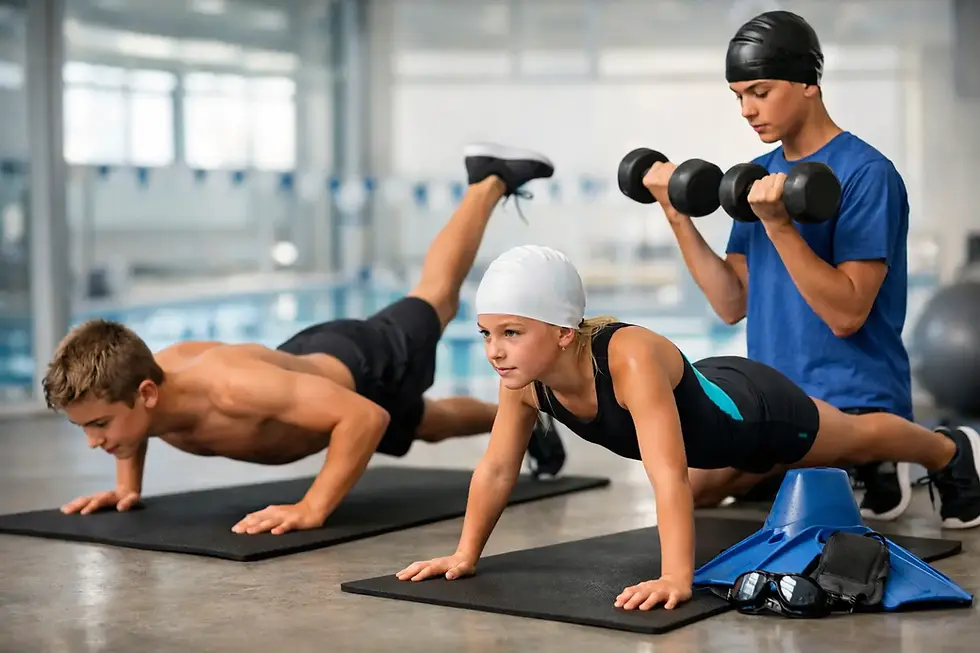
Dryland training can also become part of an athlete’s development, particularly in advanced groups. Mobility, core control, coordination, and injury-prevention exercises can improve how swimmers hold their body in the water. For younger children, dryland should be age-appropriate, supervised, and focused on movement quality rather than heavy training.
Meets Build Confidence, Not Just Rankings
A swim meet gives athletes a chance to test skills under pressure. They learn how to warm up, listen for event calls, step onto the blocks, race within the rules, and recover after a result. Those experiences can be powerful, even when the time on the scoreboard is not what they hoped for.
The healthiest early goal is often simple: complete the race, use the skills practiced, and learn one thing for next time. A personal best is worth celebrating, but it should not be the only measure of a good meet. A swimmer may improve by maintaining better stroke form, executing a cleaner turn, or managing pre-race nerves with more confidence.
Parents set the tone here. After a race, try asking, “What felt better than last time?” or “What do you want to practice this week?” before asking about place or time. That keeps attention on growth and gives children permission to enjoy the process.
There will be difficult days. Goggles leak. Starts go wrong. A swimmer may be disqualified for a technical error or miss a goal time. These moments are part of the sport. In a supportive team culture, athletes learn that mistakes are feedback, not a reason to quit.
Finding the Right Team Environment
The right club combines standards with encouragement. Families should expect organized group placement, qualified coaching, clear communication, safety policies, and a culture where swimmers are treated with respect. A serious program can still be welcoming. In fact, young athletes usually work harder when they feel safe, known, and connected to their teammates.
Look for coaches who explain expectations clearly and give swimmers useful feedback. “Try harder” has limited value. “Keep your eyes down through the breakout” gives a child something specific to practice. Good coaching is direct, patient, and consistent.
Team culture also matters when swimmers progress at different speeds. Children should understand that earning a new group or qualifying for a meet is something to be proud of, but not a reason to compare themselves harshly with others. Every athlete brings a different starting point, learning curve, and set of strengths.
Competitive swimming asks young athletes to show up, listen, repeat, and improve. That can be demanding. It can also be one of the most empowering experiences a child has. Start with sound technique, choose a group that meets your swimmer where they are, and let each practice become the next confident step forward.


Comments