

How to Build Swim Endurance for Young Swimmers

A young swimmer can finish a hard practice completely exhausted and still not be building true endurance. If their head lifts every breath, their kick creates drag, or every stroke fights the water, more laps simply reinforce the struggle. Knowing how to build swim endurance starts with a better goal: help swimmers cover more distance with calm, repeatable technique.
For families, endurance can sound like a simple fitness issue. In swimming, it is a skill issue, too. The swimmer who moves efficiently has more energy available for training, racing, and enjoying the sport. That is why a technique-first approach builds a stronger foundation than asking a child to grind through endless lengths.
What Swim Endurance Really Means
Swim endurance is the ability to maintain effective form and a controlled effort over time. It is not just the ability to survive a long set. A swimmer with developing endurance can hold their body position, keep a consistent breathing pattern, and make sound technical choices even when fatigue starts to build.
For a beginner, this might mean swimming several short lengths without stopping or panicking. For a more experienced athlete, it could mean holding a steady pace across repeated 100s while maintaining the same stroke count and turns. The standard changes as the swimmer develops, but the principle stays the same: quality must lead quantity.
Parents should also know that endurance does not build in a straight line. Growth spurts, school schedules, illness, and time away from the pool can all affect how a swimmer feels. A challenging day is not always a sign of poor fitness. Coaches look for the long-term trend: more control, better recovery, and greater confidence over weeks and months.
Build Technique Before Adding Distance
The fastest way to limit endurance is to swim with extra resistance. When a swimmer looks forward instead of down, bends at the hips, crosses over in freestyle, or holds their breath, every length costs more energy than it should.
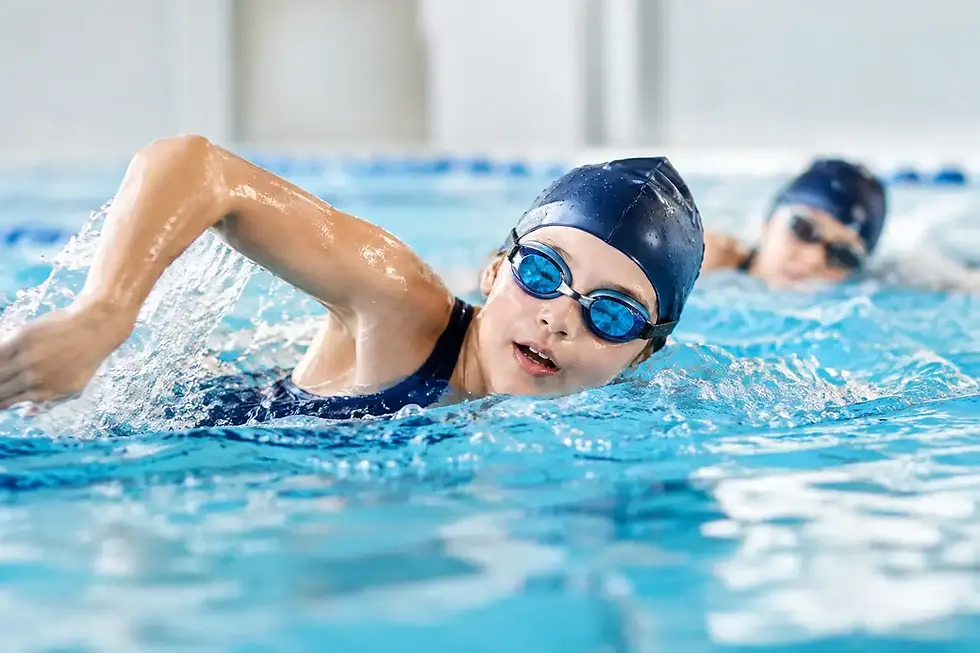
Body position is the first place to start. A long, balanced line near the surface reduces drag. Young swimmers should learn to press the chest gently into the water, keep the hips high, and look mostly toward the bottom of the pool. These details can feel small, but they change how far a swimmer travels per stroke.
Breathing deserves the same attention. Swimmers who rush to breathe often lift their heads and lose momentum. Encourage a relaxed exhale into the water, followed by a quick, low breath. Beginners may breathe whenever they need to stay calm. As their skill improves, coaches can introduce more consistent patterns that support rhythm without making breathing feel restricted.
A useful checkpoint is simple: can the swimmer repeat the same stroke shape late in practice that they used early in practice? If not, more distance may not be the answer yet. Shorter repeats with feedback will usually deliver better results.
Efficiency is not the same as swimming slowly
Some swimmers hear “easy” and start coasting. That is not the goal. Efficient swimming means moving with purpose while avoiding unnecessary effort. A strong streamline off the wall, a focused kick, and a clean hand entry all help a swimmer maintain speed with less wasted energy.
This is why drills belong in endurance training. Drills teach the positions and patterns that make longer swimming possible. They should be specific and brief, then followed by regular swimming so the athlete can apply the skill at normal pace.
Use Short Intervals to Create Lasting Endurance
Long continuous swims have a place, particularly for older and more experienced swimmers. But for most children, intervals are a more effective and engaging way to develop endurance. Instead of one exhausting 400, a coach may use multiple shorter repeats with planned rest.
For example, a swimmer working on freestyle endurance might complete 8 x 25 yards or meters with enough rest to preserve form. As their control improves, the progression could be 6 x 50, then 4 x 75, or a set that mixes distances. The distance is only one variable. Rest time, speed, stroke choice, and technical focus all shape the challenge.
Intervals teach pacing. A young swimmer learns that the first repeat should not feel like a final sprint and that the last repeat still deserves a strong finish. That awareness is valuable in both training and competition.
Progress should be gradual. Adding a little more total distance, reducing rest slightly, or asking for a more consistent pace are all reasonable next steps. Changing everything at once makes it difficult to identify what is helping and can turn a productive workout into a frustrating one.
How to Build Swim Endurance Without Overtraining
Young athletes need enough training stress to adapt, but they also need recovery to grow. The right weekly volume depends on age, experience, stroke mechanics, goals, and the quality of coaching. A new swimmer who attends one or two structured sessions per week can make meaningful progress. A competitive swimmer may train more often, but frequency should still match readiness.
Watch the swimmer, not just the schedule. Persistent shoulder pain, unusual fatigue, declining enthusiasm, trouble sleeping, or a sudden drop in coordination are signals to reduce load and speak with a coach or health professional. Soreness after a new workout can be normal. Pain is not a toughness test.
Recovery starts outside the pool. Consistent sleep, regular meals, hydration, and a balanced schedule help young swimmers arrive ready to train. For families, this does not need to become complicated. A swimmer who has eaten, had water, packed their gear, and arrived without rushing is already better prepared to learn.
Dryland training can support endurance when it is age-appropriate and well supervised. Mobility, core stability, balance, and basic bodyweight strength improve control in the water. The goal is not to exhaust swimmers before practice. It is to give them the movement foundation to hold good positions as training becomes more demanding.
Make Every Practice Have a Purpose
Endurance improves when swimmers understand what they are trying to do. “Swim more” is vague. “Hold a long body line through six 50s” gives a swimmer something they can feel and repeat.
A purposeful practice usually includes a warm-up, skill work, a main set, and an easy recovery period. The main set may target aerobic endurance, speed endurance, turns, or stroke-specific strength. Even young swimmers benefit from this structure because it teaches them how organized training works.
Variety also keeps the process sustainable. Freestyle is often the main endurance stroke, but backstroke, breaststroke, butterfly skills, kicking, and underwater streamlines all build a more complete athlete. Rotating focuses reduces monotony and can prevent one muscle group from carrying all the workload.
At Alpha Swim Club, progression works best when swimmers are placed in an environment that matches their current ability while still giving them a clear next target. A child needs enough challenge to grow, not so much that every practice feels like survival.
Track Progress Beyond the Clock
Times matter, especially for competitive swimmers, but they are not the only measure of endurance. A swimmer may be improving before the stopwatch shows a major change. They may need fewer breaks, recover faster between repeats, finish with better posture, or feel more confident in deeper water.
Coaches can track pace, stroke count, send-offs, and technical consistency. Families can focus on the signs their child notices: “I did not stop at the wall,” “I kept my face in the water,” or “I was still strong on the last one.” These are real wins, particularly for swimmers building confidence alongside fitness.
Avoid comparing one swimmer's endurance to another's. Children develop at different rates, and an athlete who is growing quickly may temporarily feel less coordinated or tire sooner. The most useful comparison is with the swimmer's own previous effort.
Let Confidence Grow With Capacity
Endurance training should leave swimmers feeling capable, not defeated. There will be hard sets and uncomfortable moments, especially as athletes move toward more advanced training. But those moments should be supported by clear coaching, achievable steps, and a team culture where effort is respected.
The swimmer who learns to stay calm, use their technique, and finish one more quality repeat gains more than fitness. They build the patience and self-belief that carry into every stage of their development. Keep the focus on steady progress, and the laps will begin to add up.


Comments